This site uses cookies to provide you with a great user experience. By using BondbloX, you accept our use of cookies.
Bond Market News
US Treasury Yields Drop with Oil Prices Easing
March 10, 2026
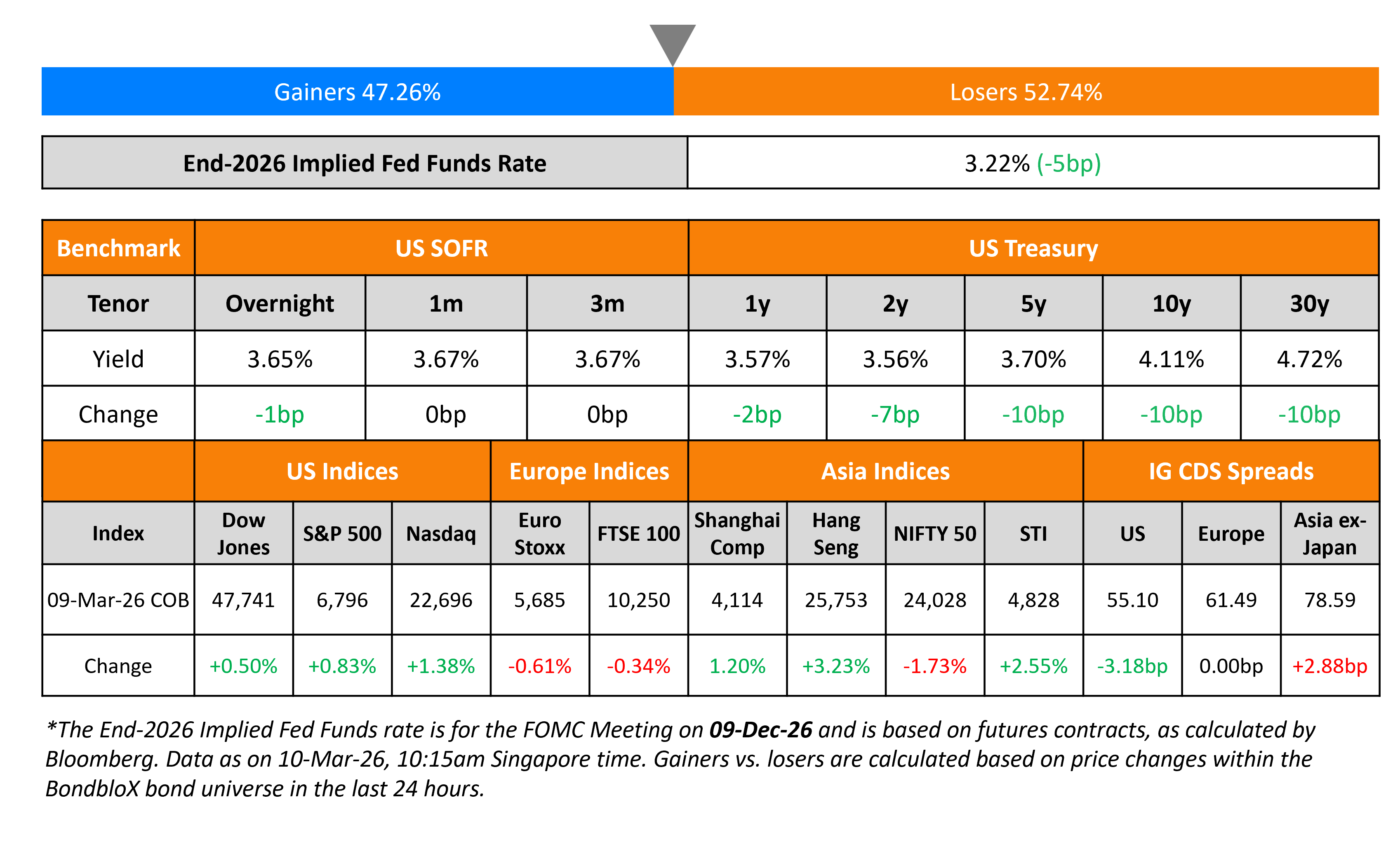
The US Treasury curve bull flattened with the 10Y and 30Y yields falling by 10bp and the 2Y easing by 7bp. US President Donald Trump indicated that the war with Iran would “be finished pretty quickly”. Markets took this positively with Brent crude falling to $93/bbl from $120/bbl early on Monday. However, strikes between Iran and Israel continue to happen.
Looking at US equity markets, the S&P and Nasdaq ended higher by 0.8% and 1.4% respectively. US IG CDS spreads tightened by 3.2bp and HY CDS spreads were 13.8bp tighter. European equity indices ended lower. The iTraxx Main CDS spreads were flat and the Crossover CDS spreads were 2.3bp wider. Asian equity markets have opened higher this morning. Asia ex-Japan CDS spreads widened by 2.9bp. China’s CPI in February rose by 1.3% YoY, higher than expectations of a 0.9% rise, and marking its highest reading in three years.
New Bond Issues
- Science City (Guangzhou) Investment $ 2Y at 4.95% area
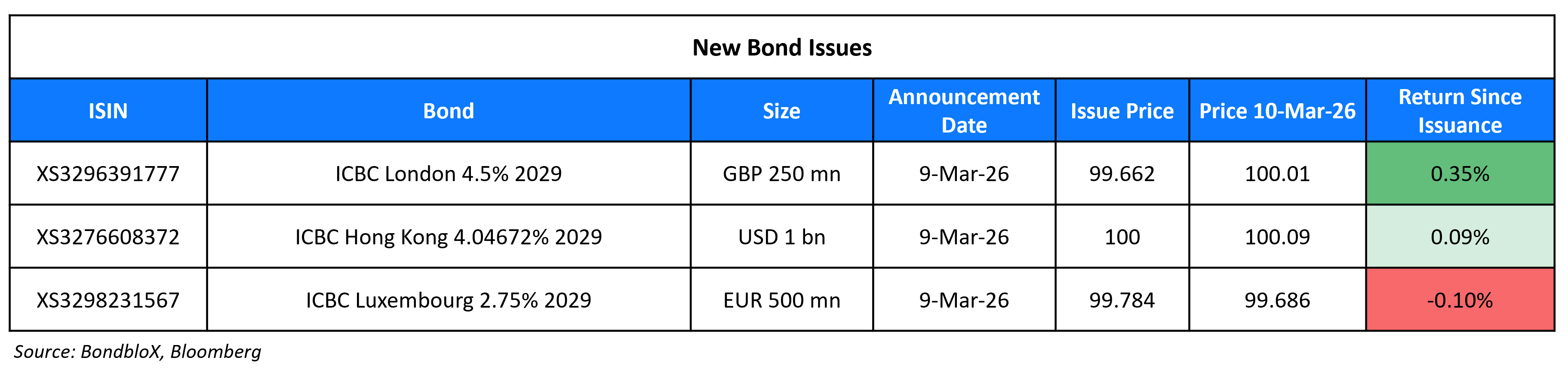
ICBC raised ~$1.92bn via a three-part multicurrency issuance.
- ICBC (HK Branch) raised $1bn via a 3Y FRN at SOFR+38bp, 62bp inside initial guidance of SOFR+100bp area
- ICBC (London) raised £250mn via a 3Y bond at 4.623%, 22bp inside initial guidance of UKT+75bp area
- ICBC (Luxembourg) raised €500mn via a 3Y bond at a yield of 2.826%, 29bp inside initial guidance of MS+55bp area
The senior unsecured notes are rated A1/A. Proceeds will be used for general corporate purposes.
New Bonds Pipeline
- JLR $ 3Y/5Y bond
- Power Construction Corp of China $ Green bond
- Kexim $ 3Y/5Y bond
Rating Changes
- Fitch Upgrades ASB Bank Limited’s Long-Term IDR to ‘AA-‘, Outlook Stable
- Moody’s Ratings upgrades Nykredit Bank A/S’ and Spar Nord Bank A/S’ long-term deposit ratings; outlook stable
- Fitch Upgrades Corporacion Quiport S.A.’s Debt to ‘B+’; Outlook Stable
- Transcontinental Inc. Downgraded To ‘BB’ From ‘BBB-‘ On Divestment Of Its Packaging Segment; Outlook Stable
- Fitch Revises Outlook on Indonesia’s Bank Central Asia to Negative; Affirms at ‘BBB’
- Icahn Enterprises L.P. Outlook Revised To Negative Amid Weaker Cash Inflows; ‘BB-‘ Ratings Affirmed
Term of the Day: Stagflation
Stagflation refers to a period of (stag)nant economic growth and high in(flation). It is an economic phenomenon when economic growth is stagnant and the unemployment rate and inflation are high. Stagflation is most commonly caused by supply shocks leading to higher commodity prices or monetary policies that increase money supply in the economy too quickly. An example of stagflation was in the US during the 1970s, when high inflation and high unemployment was at its peak on the back of a surge in commodity prices. Generally. monetary and fiscal policies are not effective at solving economic problems related to a supply side shock, hence it is tougher to get through a period of stagflation.
Talking Heads
On Stagflation Trades Sweeping Markets
Rajeev de Mello, Gama Asset
“Investors have had to increase their probability of the worst-case scenario. The challenge is the stagflationary nature of the shock.”
Matthew Haupt, Wilson Asset Management
“The risks are firmly placed to the downside from here with no clear timeline of an end to it”
Anna Wu, Van Eck Associates
“When markets encounter a black swan, everything could fall at the same time”
On Seeing Markets Mispricing Fed, ECB Rate Paths – Nohshad Shah, Citadel Securities
“If the ECB is hiking, I struggle to see the Fed cutting. And vice versa… adjustment higher in yields is something I have been calling for in recent weeks and is justified by the fundamentals”
On Raising Odds of US Market Meltdown on Iran War
Ed Yardeni, Yardeni Research
“If the oil shock persists, the Fed’s dual mandate would be stuck between the increasing risk of higher inflation and rising unemployment… If investors start expecting stagflation, a bear market is more likely”
Top Gainers and Losers- 10-Mar-26*
.png)
Go back to Latest bond Market News
Related Posts:








BondbloX Pte. Ltd. is regulated by the Monetary Authority of Singapore as a Recognised Market Operator ("RMO") and exempted from Section 49(1) of the Securities and Futures Act (Cap. 289) ("SFA") under Section 49(7) of the SFA.