This site uses cookies to provide you with a great user experience. By using BondbloX, you accept our use of cookies.
Bond Market News
HSBC, SEB and others Price $ Bonds
March 6, 2026
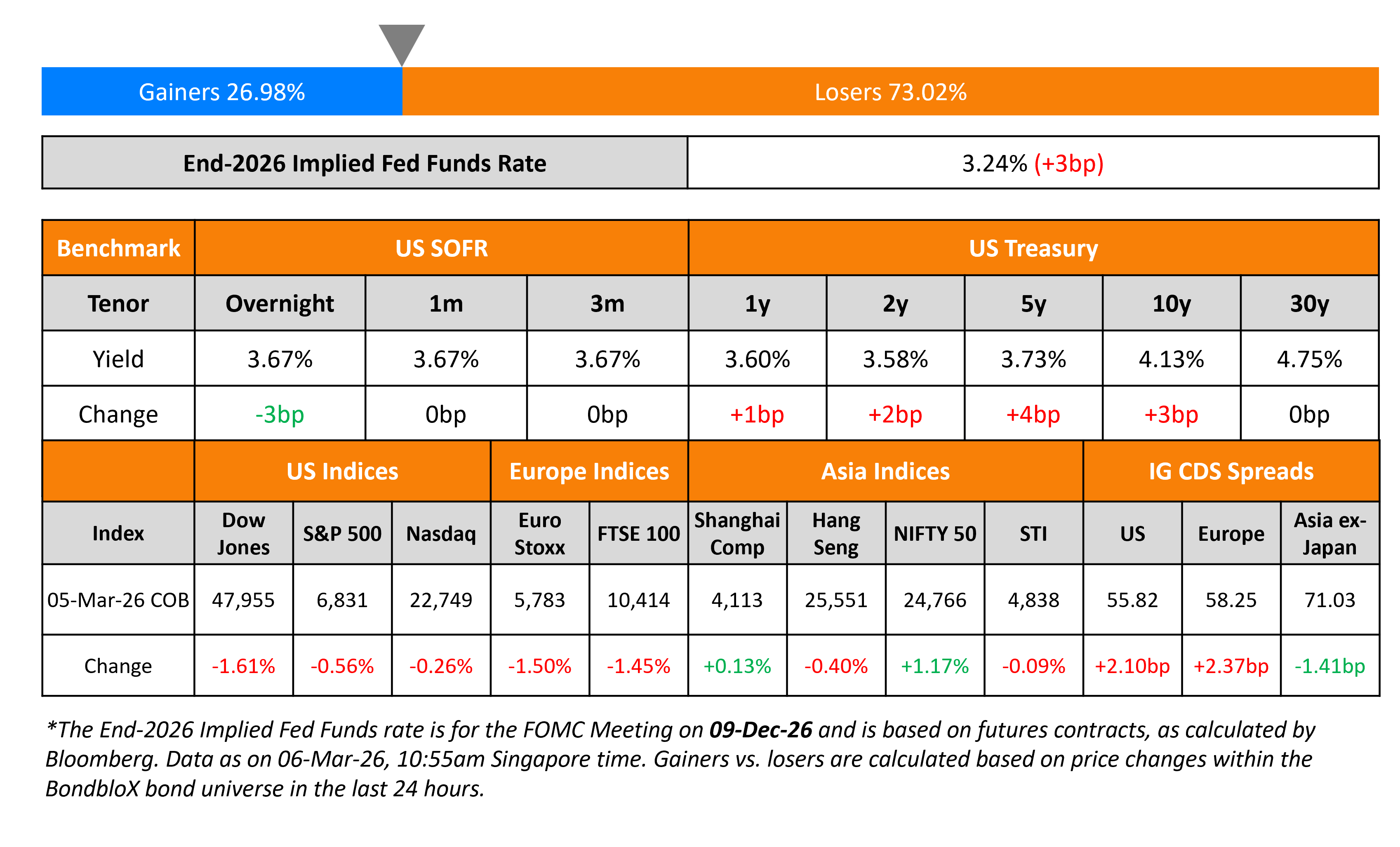
US Treasury yields continued to rise across the curve. Initial jobless claims for the prior week rose by 213k, better than the estimated 215k. The Fed’s Beige Book noted that wages rose at a modest or moderate pace in most districts and that economic expectations were optimistic. Separately, Richmond Fed President Thomas Barkin said that the Fed’s response to the Middle East tensions will depend on how long the impact on the US economy lasts.
Looking at US equity markets, the S&P and Nasdaq ended lower by 0.6% and 0.3% respectively. US IG CDS spreads widened by 2.1bp and HY CDS spreads were 10.2bp wider. European equity indices ended lower too. The iTraxx Main CDS spreads were 2.4bp wider and the Crossover CDS spreads were 9.5bp wider. Asian equity markets have opened mixed this morning. Asia ex-Japan CDS spreads tightened by 1.4bp. China set its lowest GDP growth target in over three decades, at 4.5-5.0% for 2026. This was also its first formal growth downgrade since 2023, when the target was lowered to 5% from 5.5% at the time.
New Bond Issues
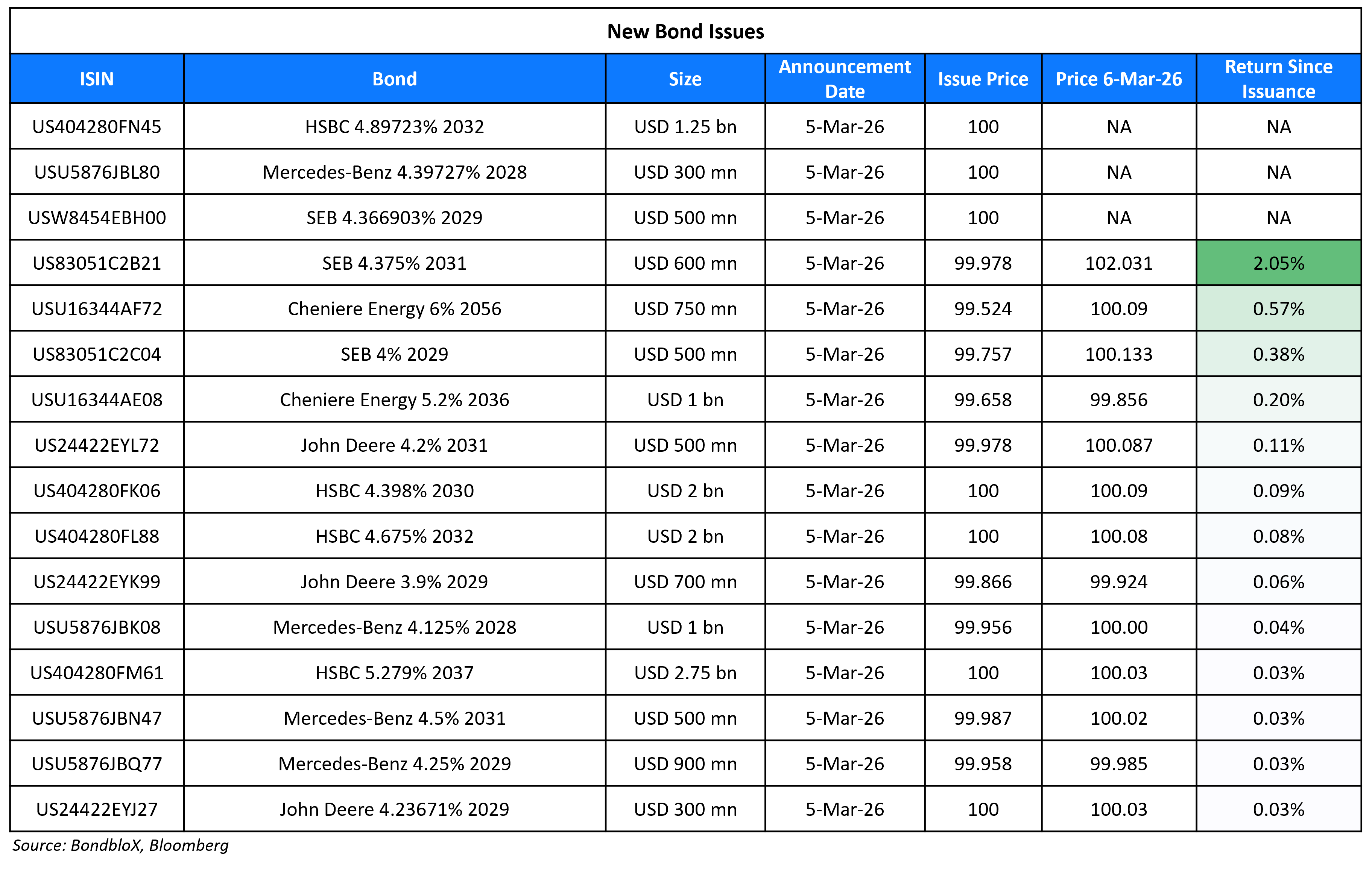
HSBC raised $8bn via a four-part deal. Details are given in the table below:
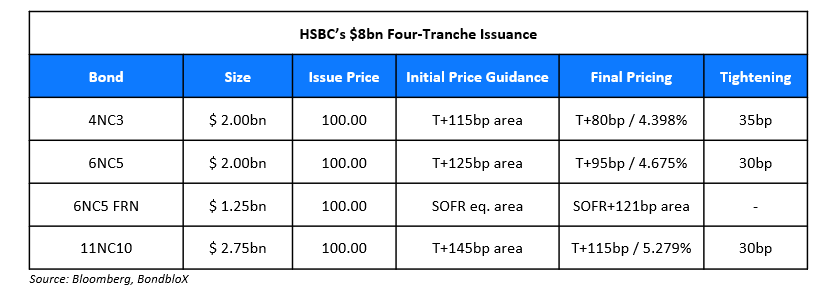
The senior unsecured notes are rated A3/A-/A+. Proceeds will be used for general corporate purposes.
Skandinaviska Enskilda Banken (SEB) raised $1.6bn via a three trancher. It raised:
- $500mn via a 3Y bond at a yield of 4.087%, 27bp inside initial guidance of T+75bp area.
- $500mn via a 3Y FRN at SOFR+68bp vs. initial guidance of SOFR equivalent.
- $600mn via a 5Y bond at a yield of 4.38%, 25bp inside initial guidance of T+90bp area.
The senior preferred notes are rated Aa3/AA-/AA. Proceeds will be used for general corporate purposes.
Cheniere Energy raised $1.75bn via a two-trancher. It raised $1bn via a 10Y bond at a yield of 5.244%, 30bp inside initial guidance of T+140bp area. It raised $750mn via a 30Y bond at a yield of 6.035%, 32bp inside initial guidance of T+168bp area. The senior unsecured notes are rated Baa2/BBB/BBB. Proceeds will be used for general corporate purposes, which may include, repayment/refinancing existing debts, funding capex, working capital and other business opportunities.
Rating Changes
- Moody’s Ratings upgrades Tajikistan’s ratings to B2 and changes outlook to stable
- Raizen S.A. Downgraded To ‘CCC-‘ From ‘CCC+’ On Heightened Restructuring Risk; Outlook Negative
- Tullow Oil PLC Downgraded To ‘CC’ From ‘CCC-‘ On Virtual Certainty Of Default; Outlook Negative
- Moody’s Ratings upgrades Liquid Telecom to Caa1, places ratings on review for upgrade
- Lumen Technologies Inc. Outlook Revised To Positive From Stable; ‘B-‘ Rating Affirmed
- LG Chem, LG Energy Solution Outlook Revised To Negative On Persistent Profitability Pressure; ‘BBB’ Ratings Affirmed
Term of the Day: Credit Default Swap (CDS)
A Credit Default Swap (CDS) is a financial contract between two counterparties that allows an investor to “swap” or offset the credit risk with another investor. CDS acts like an insurance policy wherein the buyer makes regular payments to the seller to protect itself from an issuer default. In the event of a default, the buyer receives a payout, typically the face value of the bond or loan, from the seller of the CDS as per the agreement. CDS spreads are a commonly used metric to track the market-priced creditworthiness of an issuer. A widening (increase) in CDS spreads indicates a deterioration in creditworthiness and vice-versa.
Talking Heads
On Banks Signalling Portfolio Recalibration on ME Tensions
Mathieu Racheter – Julius Baer
“In this environment, discipline and a tilt towards defensive quality remain prudent. While oil and gas stocks have historically provided a partial hedge against supply-driven price spikes – an area investors may want to look at from a portfolio-construction perspective, even if we do not actively advocate an overweight.”
Swiss bank UBP
“At portfolio-construction level, we are emphasising risk mitigation through our fundamentally positive view on gold, as its convex profile provides valuable protection despite current valuations.”
On Long Trusted Haven Assets Failing
Christoph Rieger – Commerzbank AG
“Risk-off is not what it used to be. ‘Safe Assets’ don’t work as a hedge in a crisis where all policy options call for more supply and against lower rates. Some market moves make sense, others don’t.”
On Bond Traders Seeing Increased Chance of No Rate Cuts This Year
Dan Carter – Fort Washington Investment Advisors
“When the price of oil spiked, we have to think about its impact on inflation. This is going to impact inflation in the upward direction and makes it less likely that the Fed is going to be able to cut.”
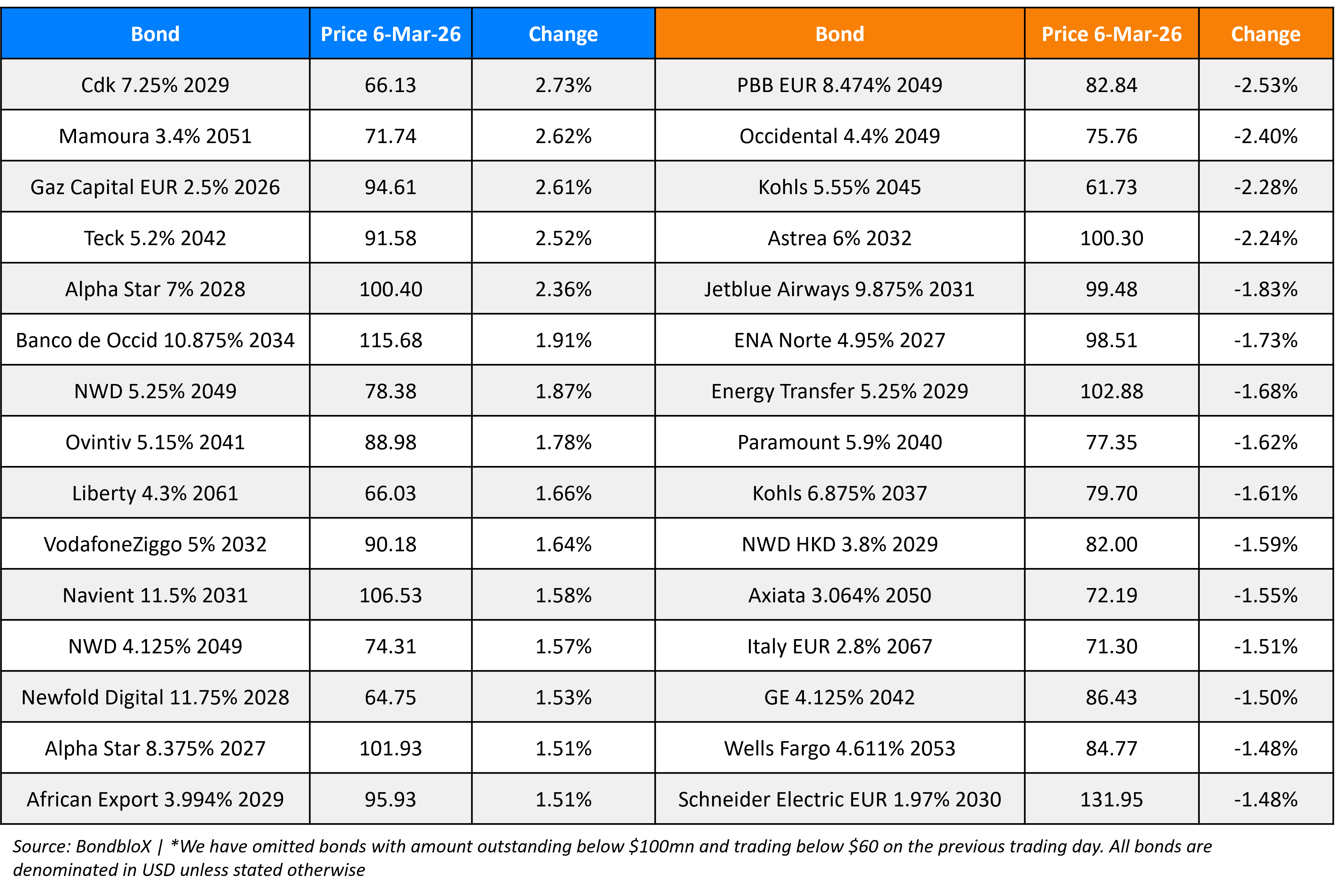
Top Gainers and Losers- 06-Mar-26*
Go back to Latest bond Market News
Related Posts: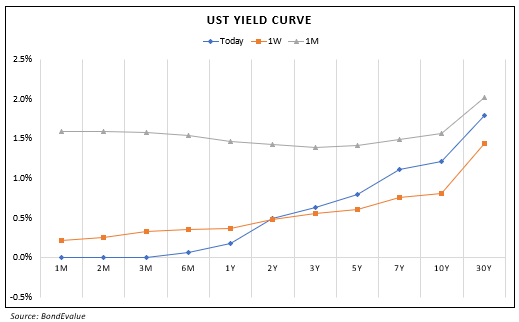








BondbloX Pte. Ltd. is regulated by the Monetary Authority of Singapore as a Recognised Market Operator ("RMO") and exempted from Section 49(1) of the Securities and Futures Act (Cap. 289) ("SFA") under Section 49(7) of the SFA.