This site uses cookies to provide you with a great user experience. By using BondbloX, you accept our use of cookies.
Bond Market News
Angola, CBA, NatWest and others Price $ Bonds
March 25, 2026
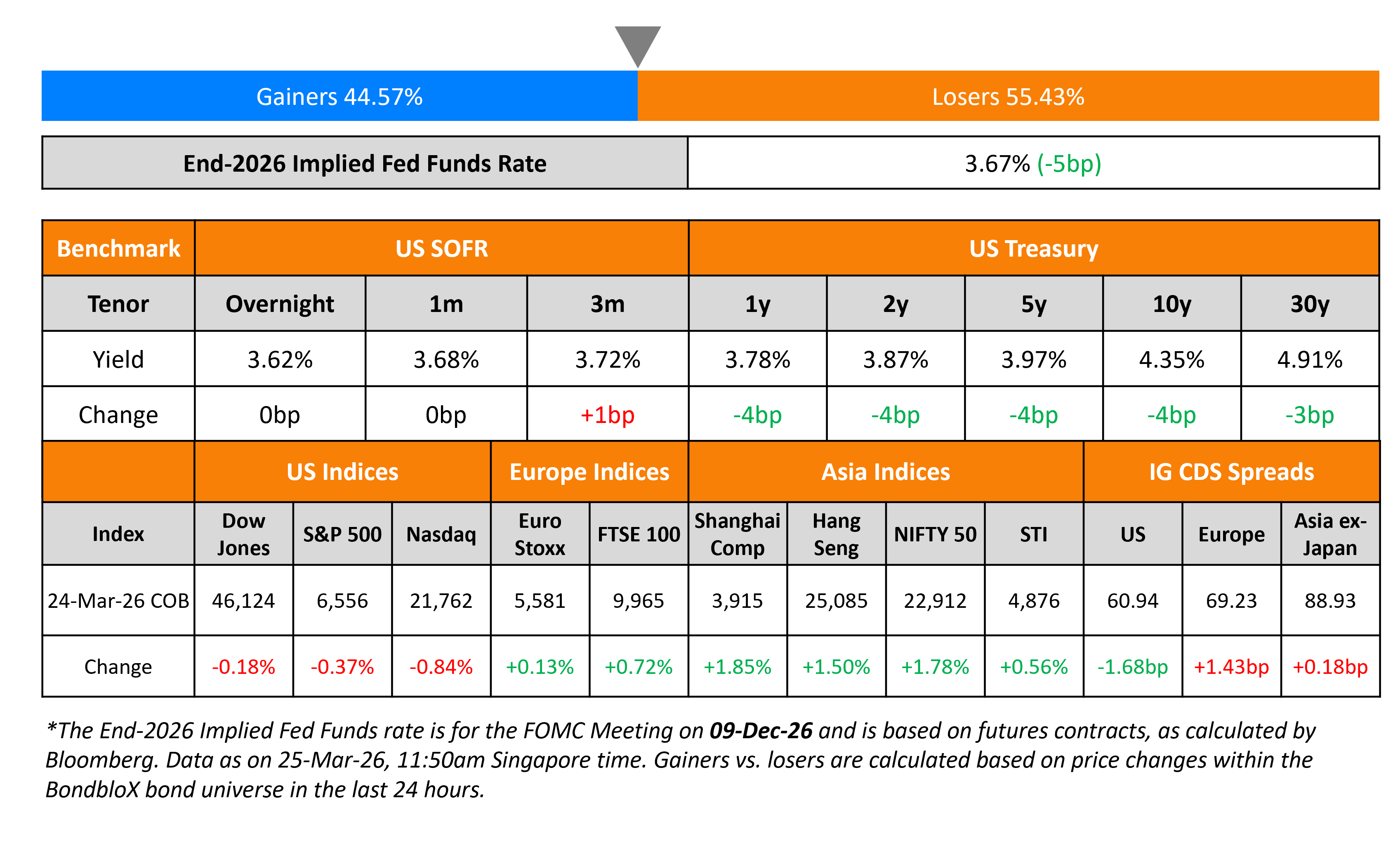
US Treasury yields were lower by ~4bp across the curve. The geopolitical space continues to remain uncertain – US President Donald Trump noted that Iran gave “a very big present, worth a tremendous amount of money” in the form of an oil-and gas-related concession related to the Strait of Hormuz. However, at the same time reports also circulated that the US was preparing to send 3,000 army troops to the Middle East. Brent Crude eased further to trade at under $95/bbl. On the data front, the preliminary US S&P Manufacturing PMI for March came in at 52.4, beating the surveyed 51.5 reading. The Services PMI reading however came in at 51.1, missing expectations of 52.0. Separately, the US Treasury’s 2Y note auction witnessed weak demand, tailing by 1.8bp, with a bid-to-cover ratio of 2.44x (the lowest since May 2024). Markets are currently not pricing in any rate action by the Fed this year.
Looking at US equity markets, the S&P and Nasdaq ended lower by 0.4% and 0.8% respectively. US IG CDS spreads tightened by 1.7bp and HY CDS spreads were 7bp tighter. European equity indices ended higher. The iTraxx Main CDS spreads were 1.4bp wider while the Crossover CDS spreads were flat. Asian equity markets have opened in the green this morning. Asia ex-Japan CDS spreads widened by 0.2bp.
New Bond Issues
- LG Energy Solutions $ 3Y/5Y/5Y FRN/10Y at T+150/T+165/SOFR eq/T+200bp areas
.png)
Angola raised $2.5bn via a two-trancher. It raised $1.5bn via a 7Y bond at a yield of 9.375%, 25bp inside initial guidance of 9.625% area. It also raised $1bn via a 11Y bond at a yield of 9.875%, 25bp inside initial guidance of 10.125% area. The senior unsecured notes are rated B3/B-/B-. Proceeds will be used for budgetary purposes and to purchase its outstanding 8.25% 2028s.
CBA raised $2bn via a two-part deal. It raised $1.1bn via a 3Y bond at a yield of 4.355%, 27bp inside initial guidance of T+70bp area. It raised $900mn via a 3Y FRN at SOFR+63bp vs. initial guidance of SOFR equivalent area. The senior secured notes are rated Aa2/AA-/AA. Proceeds will be used for general corporate purposes.
NatWest Markets raised $2.3bn via a three-tranche deal. It raised:
- $350mn via a 3Y FRN at SOFR+93bp vs. initial guidance of SOFR equivalent area.
- $1.2bn via a 3Y bond at a yield of 4.654%, 27bp inside initial guidance of T+100bp area. The new bond is priced at a new issue premium of 15bp over its existing 4.807% 2029s that currently yield 4.50%.
- $750mn via a 5Y bond at a yield of 4.893%, 25bp inside initial guidance of T+112.5bp area. The new bond is priced at a new issue premium of ~8bp over its existing 5.115% 2031s that currently yield 4.81%
The senior unsecured notes are rated A1/A/AA-. Proceeds will be used for general corporate purposes.
Glencore raised $2.5bn via a three-trancher. It raised:
- $650mn via a long 5Y bond at a yield of 4.939%, 28bp inside initial guidance of T+120bp area. The new bond is priced at a new issue premium of ~9bp over its existing 2.85% 2031s that currently yield 4.85%.
- $650mn via a long 7Y bond at a yield of 5.226%, 28bp inside initial guidance of T+130bp area. The new bond is priced at a new issue premium of ~14bp over its existing 6.5% 2033s that currently yield 5.09%.
- $1.2bn via a 10Y bond at a yield of 5.508%, 28bp inside initial guidance of T+140bp area.
The senior unsecured notes are rated A3/BBB+. Proceeds will be used for general corporate purposes.
Danske Bank raised $1.6bn via a two-part offering. It raised $850mn via a 3NC2 bond at a yield of 4.662%, 25bp inside initial guidance of T+100bp area. It raised $750mn via a 6NC5 bond at a yield of 4.999%, 27bp inside initial guidance of T+125bp area. The senior non-preferred notes are rated A3/A-/A+. Proceeds will be used for general corporate purposes.
Citadel Securities Global raised $1.5bn via a two-trancher. It raised $750mn via a long 5Y bond at a yield of 5.332%, 30bp inside initial guidance of T+160bp area. It raised $750mn via a 10Y bond at a yield of 5.96%, 28bp inside initial guidance of T+185bp area. The senior secured notes are rated Baa3/BBB-. Proceeds will be used for working capital and general corporate purposes.
Enbridge raised $2bn via a two-trancher. It raised $1bn via a 5Y bond at a yield of 4.882%, 27bp inside initial guidance of T+110bp area. It also raised $1bn via a 10Y bond at a yield of 5.46%, 25bp inside initial guidance of T+130bp area. The senior unsecured notes are rated Baa2/BBB+/BBB+. Proceeds will be used for general corporate purposes, repay existing debt, finance future growth opportunities, including acquisitions, if any, and capital expenditures.
Korea National Oil raised $1.2bn via a three-part deal. It raised:
- $400mn via a 3Y bond at a yield of 4.61%, 25bp inside initial guidance of T+90bp area.
- $500mn via a 3Y FRN at SOFR+80bp vs. initial guidance of SOFR equivalent area.
- $300mn via a 5Y bond at a yield of 4.757%, 25bp inside initial guidance of T+95bp area.
The senior unsecured notes are rated Aa2/AA (Moody’s/S&P). Proceeds will be used for general corporate purposes and will not be used for any activities relating to the construction or development of oil sand projects.
Swedbank raised $650mn via a 5Y bond at a yield of 4.898%, 27bp inside initial guidance of T+115bp area. The senior non-preferred note is rated A3/A/AA-. Proceeds will be used for general corporate purposes.
Rating Changes
- Fitch Upgrades Seagate Technology to ‘BBB-‘; Outlook Stable
- Coeur Mining Inc. Upgraded To ‘BB’ On Acquisition Of New Gold And Strong Credit Metrics; Outlook Positive
- Moody’s Ratings upgrades Coeur’s CFR to Ba2; assigns Ba3 rating to the new exchange notes; outlook stable
- Toyota Industries Upgraded To ‘A+’ On Group’s Increased Stake; Outlook Stable
- New Gold Inc. Upgraded To ‘BB’ From ‘B+’ On Acquisition By Coeur Mining Inc.; Off CreditWatch Positive; Outlook Positive
- Moody’s Ratings downgrades Frigorifico Concepcion’s ratings to Caa1; outlook is changed to negative
- Moody’s Ratings downgrades Toyota Industries to A3; outlook negative
- Dish DBS Corp. ‘CCC+’ Rating Revised To CreditWatch Developing From Positive On Restructuring Support Agreement
Term of the Day: Payment-In-Kind (PIK) Bonds
Payment-in-kind (PIK) is a type of bond for which, on each coupon payment date, the accrued coupon is capitalized and fully or partially paid in the form of additional bonds or added to the principal amount. PIK bonds are typically bonds with deferred coupons. These are riskier for investors due to more credit risk with respect to the PIK interest amount, payment of which can be deferred until maturity. Given this inherent higher risk, interest rates for PIK bonds are higher than for conventional bonds. Generally, issuers with liquidity stresses that are able to pay coupons in non-cash form issue these notes.
Talking Heads
On Investors Betting on a Rate Hike That’s Not That Likely
Veronica Clark, Citigroup
“Of course the oil shock is a new inflation risk, but it’s also, if anything, a negative growth shock and maybe negative for employment”
Jonathan Pingle, UBS
“The real reason you would raise rates is if the labor market looks strong”
Krishna Guha and Gang Lyu, Evercore ISI
“Labor markets are much less tight, there is no pent-up demand/pandemic style fiscal, and to date supply chain disruptions remain moderate”
On China Emerging as Debt-Funding Hub for Foreigners During Iran War
Lei Wang, S&P Global (China)
“Offshore markets are flexible but far more exposed to global shocks, while the panda bond market has proved itself to be a stable and resilient channel… makes it an increasingly important consideration for global issuers in addition to the cheaper funding costs”
Chin Chin Koh, UOB
“The onshore yuan market benefits from a larger and more established domestic investor base, which can provide deeper liquidity even during periods of global volatility”
On Pimco Takes Contrarian View as Market Bets on Global Rate Hikes
“Central banks are unlikely to match the market’s recent repricing of policy rate expectations… repricing of central bank expectations in response to the Middle East conflict has created localized volatility and opportunities to invest”
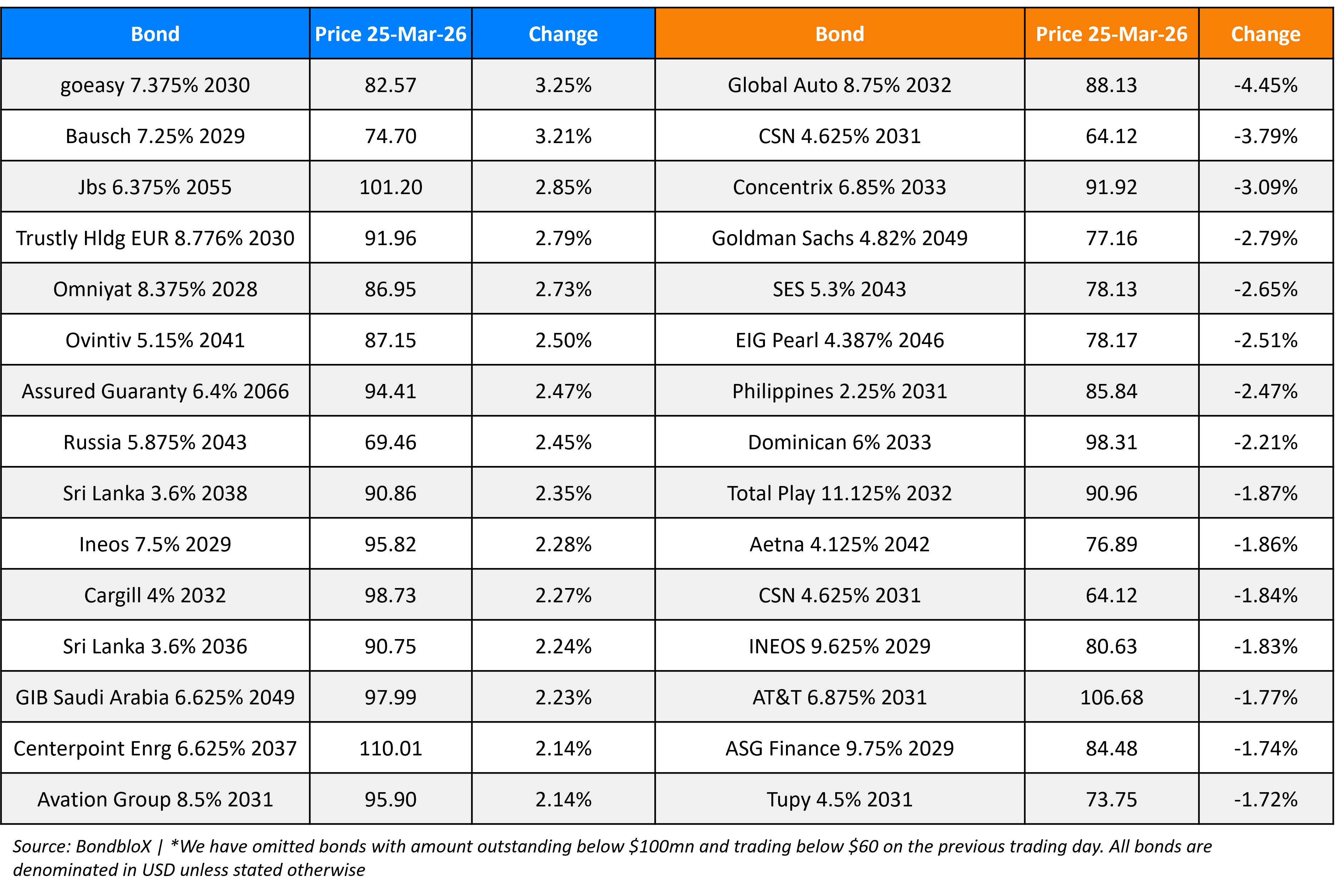
Top Gainers and Losers- 25-Mar-26*
Go back to Latest bond Market News
Related Posts:








BondbloX Pte. Ltd. is regulated by the Monetary Authority of Singapore as a Recognised Market Operator ("RMO") and exempted from Section 49(1) of the Securities and Futures Act (Cap. 289) ("SFA") under Section 49(7) of the SFA.