This site uses cookies to provide you with a great user experience. By using BondbloX, you accept our use of cookies.
What are the basic features of bonds?
Bonds have different components and terminologies that investors must know before investing in them. Let’s cover these topics in simple terms and try to understand them:
- Principal: Principal refers to the amount of money that the bond investor will receive from the bond once it matures. Sometimes it is also referred to as the nominal value, face value or par value
- Maturity Date: This refers to the date at which an investor can expect to receive the principal investment from the bond, subject to default risks. Essentially on this date, the investor’s initial investment will be returned, unless the issuer declares a default at any time over the life of the bond. It is worth noting that for bonds with call options, redemption can take place well before the maturity date. Do note that there is a category of bonds known as ‘Perpetual bonds’ that do not have a maturity date, however they can be redeemed by the issuers at specific times during the life of the bond (known as call date). Do note that for perpetual bonds on the BondbloX App, the maturity year is indicated as 2049. For example, the HSBC 6.25% Perpetual bond is identified on the BondbloX App as HSBC 6.25% 2049.
- Coupon: A bond’s coupon refers to the regular payment that the issuer promises to pay the investor over the life of the bond. The payment frequency could be annual, semi-annual or quarterly and the coupon is stated in annualized terms. While most bonds have a ‘fixed rate coupon’ throughout the life of the bond, there are ‘floating rate notes’ where the coupons keep changing regularly depending on market rates. There are also ‘fixed-to-floating’ bonds that have a change in the coupon rate during the life of the bond at a particular reset date. This is more common with perpetual bonds.
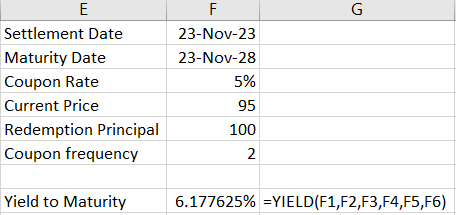
- Yield: Yield aka ‘Yield to Maturity’ simply refers to the expected return that an investor would make by investing in that bond. There are several types of yields, each calculated in a different manner. The yield on a bond can easily be calculated on MS Excel, using the following inputs and the formula below (do try it out!)
- Bond Price: This is the current market price of the bond that is being traded in the secondary market at which buyers and sellers trade the bond. A fundamental concept to understand is that a bond’s price is inversely proportional its yield or interest rates. Thus, if yields or interest rates rise, the bond’s price falls and if yields fall, its price goes up.
- Duration: Bond duration is a metric that measures a bond’s sensitivity to interest rates. The duration of a bond indicates how much a bond’s price is expected to rise/fall if interest rates fall/rise by 100 basis points or 1%. Thus, by knowing the duration of a bond, investors can understand the fluctuation expected in their bond investments as interest rates are a key in determining the extent of the move. To learn more about bond duration in detail with examples, click here
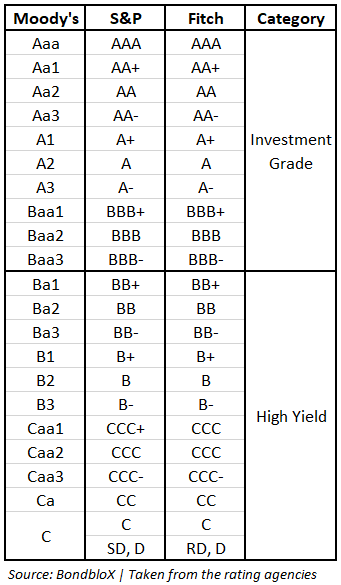
- Credit Ratings: Credit rating refers to the grading given by ‘credit rating agencies’ that indicates creditworthiness of the bond issuer as well as that particular bond. The three major international rating agencies that rate issuers are Moody’s, Standard & Poor’s (S&P) and Fitch. They analyze the financial health of the issuer by considering internal and external factors when assigning a rating. Broadly, credit ratings are classified into two main categories as shown in the image below, across the three rating agencies. As you go lower down on the credit rating scale, the perceived risk increases. It is important to note that the bond issuer can have a different credit rating as compared to the same issuer’s bond due the terms and conditions of that bond.
Get the latest news on bonds
Receive curated global bond market news directly in your inbox everyday to stay updated
Learn more about Bond Investing










BondbloX Pte. Ltd. is regulated by the Monetary Authority of Singapore as a Recognised Market Operator ("RMO") and exempted from Section 49(1) of the Securities and Futures Act (Cap. 289) ("SFA") under Section 49(7) of the SFA.